Honeycombing in Concrete? Here is the Site Solution! Real Site Reasons & Instant Solutions
In the construction industry, there are several defects that appear frequently on building sites. Many of these issues are ignored or temporarily hidden without understanding their real cause or long-term impact. One such defect is honeycombing in concrete.
Almost every construction professional has seen honeycombing at some point on a site. However, very few people truly understand why it happens and how serious it can be for a structure.
Some people treat honeycombing as just a surface defect. Others simply cover it with plaster or cement mortar and move on. But the real question is — is honeycombing in concrete only a cosmetic issue, or is it a structural danger?
To answer this, we must first understand the engineering reality behind honeycombing. In this article, we will explore the technical reasons, practical site mistakes, and structural risks associated with honeycombing in concrete.
If you are a house owner planning construction, a civil engineering student, or a site engineer, understanding this defect is extremely important. Ignoring honeycombing today can create serious structural problems in the future.
What is Honeycombing in Concrete?
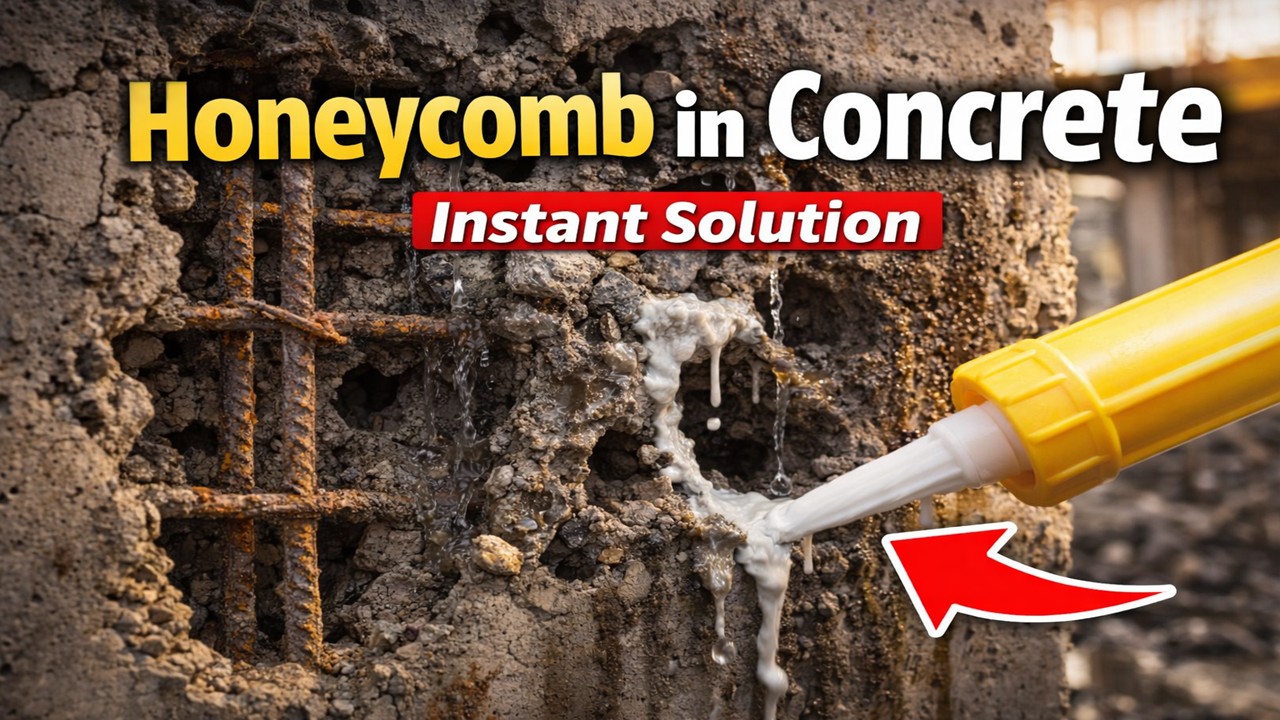
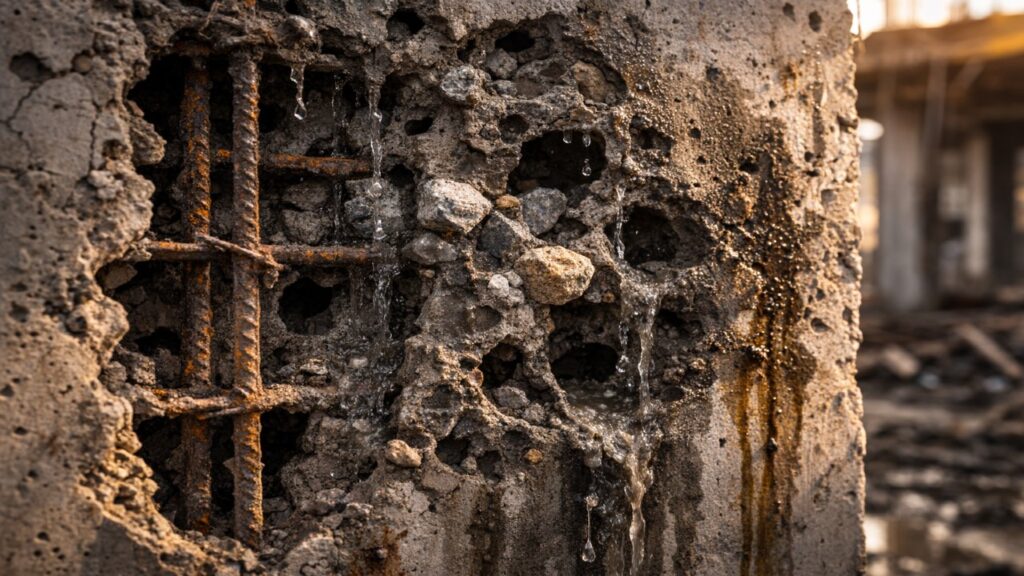
Honeycombing in concrete is a concrete defect in which voids, cavities, and gaps remain inside the concrete after it hardens. Due to these voids, coarse aggregates become visible on the surface and the concrete appears porous.
The pattern formed often resembles the structure of a honeybee hive, which is why this defect is known as honeycombing.
Honeycombing in concrete is most commonly observed in areas such as:
Beams
Columns
Beam-column junctions
Heavily reinforced sections
These areas are more vulnerable because concrete flow and compaction become difficult due to reinforcement congestion.
Why Honeycombing in Concrete Occurs?
It is important to understand that honeycombing in concrete itself is not the root problem. Instead, it is the result of mistakes made during the concrete construction process.
In simple terms, honeycombing is a symptom of poor construction practice. If the root cause is ignored and the defect is simply covered with plaster, the underlying structural issue may remain hidden and can lead to serious failures later.
Let us understand the most common causes of honeycombing in concrete on construction sites.
Improper Vibration of Concrete
One of the most common reasons for honeycombing is improper vibration during concrete placement.
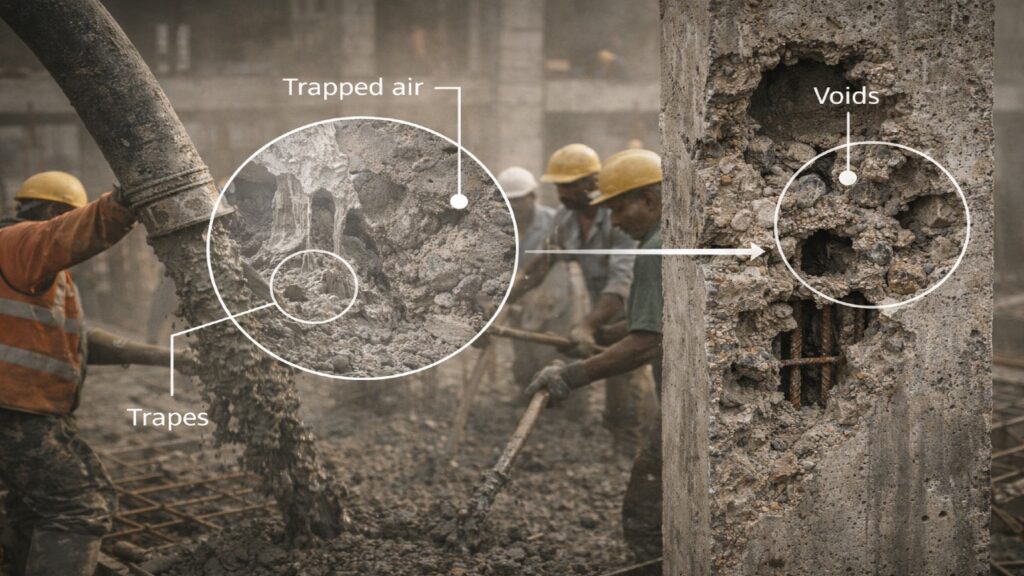
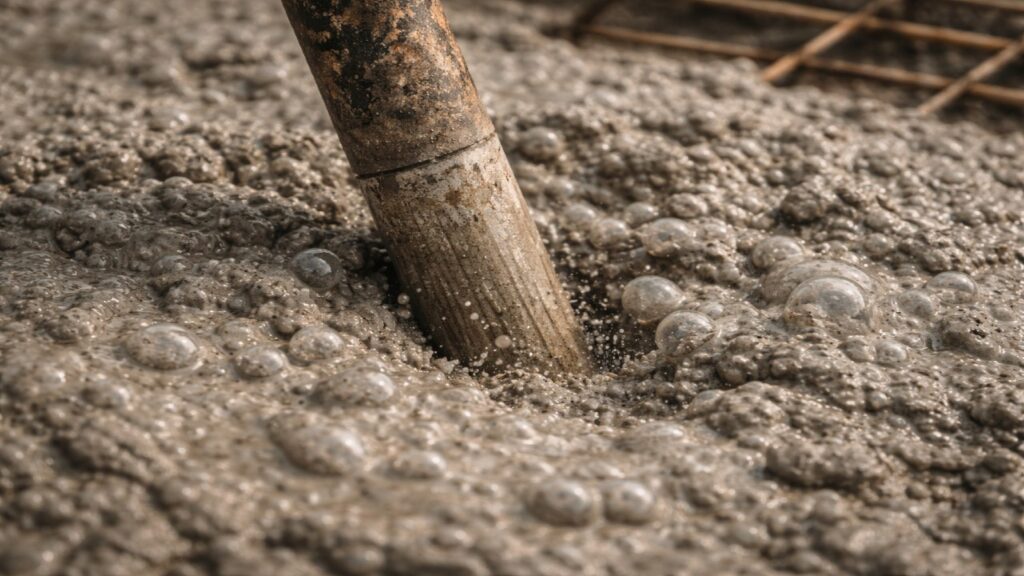
Vibration plays a crucial role in concrete compaction. Its primary function is to remove trapped air from fresh concrete and ensure that the mix becomes dense and properly packed.
If vibration is not done properly, air pockets remain trapped inside the concrete. These trapped air pockets later become voids, which appear as honeycombing when the formwork is removed.
On many construction sites, vibration is either neglected or done carelessly. Sometimes laborers move the vibrator only near the surface or remove it too quickly. In columns and beams, the vibrator is often not inserted to the full depth.
As a result, the outer concrete surface may look acceptable, but once the shuttering is removed, voids and exposed aggregates become visible.
Poor Workability of Concrete
Another major reason behind honeycombing is low workability of the concrete mix.
If concrete is too stiff or too dry, it cannot flow properly between reinforcement bars. In heavily reinforced sections, concrete requires sufficient workability to pass through the steel bars and fill every corner of the formwork.
When workability is low, concrete gets stuck between reinforcement bars and leaves empty spaces. These spaces later become honeycombing.
Incorrect mix proportions can also cause problems. Sometimes workers add too little water, making the mix very stiff. On the other hand, adding excessive water can cause segregation, where cement paste separates from aggregates.
When segregation occurs, aggregates settle at the bottom and cement paste moves upward. This uneven distribution can also lead to honeycombing.
Improper Shuttering and Formwork
Poor quality shuttering is another major cause of honeycombing.
If formwork is not properly sealed and contains gaps or loose joints, cement slurry leaks out during concreting. Once the slurry escapes, only aggregates remain inside the formwork.
Without sufficient cement paste, aggregates cannot bond properly. When the formwork is removed, the surface appears rough and porous, clearly showing honeycombing.
This problem is particularly common in column shuttering because the pressure of fresh concrete is high. If joints are not properly sealed, slurry leakage becomes inevitable.
Improper Concrete Placement
Concrete placement technique is also extremely important.
Concrete should never be dropped from excessive heights. When concrete falls from a high level, segregation occurs and the mix components separate from each other.
The heavier aggregates settle in one place while cement paste spreads elsewhere. This uneven distribution creates voids and leads to honeycombing.
To prevent this, concrete should always be placed in layers and each layer must be properly vibrated.
Unfortunately, on many construction sites concrete is poured from the top in a single operation, especially in columns and walls. This careless method often results in honeycombing.
Congested Reinforcement
Reinforcement congestion is another major reason for honeycombing.
When too many steel bars are placed in a beam or column and clear spacing becomes insufficient, concrete cannot flow properly between the bars.
Even with vibration, the concrete may fail to settle properly. As a result, voids form around the reinforcement and honeycombing develops.
This issue is particularly common at beam-column joints and heavily loaded structural members.
Ironically, over-reinforcement intended to strengthen the structure may actually reduce construction quality and create defects.
Poor Mix Design and Incorrect Aggregate Size
Incorrect mix design also increases the risk of honeycombing in concrete.
Aggregate size should always be selected according to the size of the structural member and spacing of reinforcement.
If aggregates are too large and reinforcement spacing is small, the aggregates may get stuck between the bars. Cement paste cannot reach these areas, leaving empty spaces inside the concrete.
This leads directly to void formation and honeycombing.
One of the biggest indirect causes of honeycombing is lack of proper supervision.
When the site engineer is absent or workers are not properly trained, essential steps like vibration, proper concrete placement, and correct shuttering alignment are often neglected.
In many projects, pressure to finish work quickly results in compromised construction quality.
Honeycombing is most commonly observed on sites where supervision and quality control are weak.
Is Honeycombing in Concrete Dangerous?
Yes, honeycombing can be dangerous depending on its depth, location, and severity.
If honeycombing is very shallow and limited to the surface, it may be considered a cosmetic defect. However, deep honeycombing can significantly affect structural performance.
Honeycombing reduces the effective cross-section of concrete, which directly decreases the load carrying capacity of the structure.
Another serious issue is that honeycombed concrete becomes highly porous. Water, air, and chemicals can easily penetrate through the voids and reach the reinforcement steel.
When reinforcement starts corroding, rust expands in volume and creates internal pressure inside the concrete. This eventually causes cracks and reduces the structural life of the building.
Common Site Mistake: Hiding Honeycombing in Concrete with Plaster
A very common mistake on construction sites is simply covering honeycombing with plaster or cement mortar.
While this may make the surface appear smooth, the internal voids remain unchanged. The structural weakness continues to exist inside the concrete.
This hidden defect may not show immediate symptoms but can lead to serious structural problems in the future.
Repair Methods for Honeycombing in Concrete
Repairing honeycombing should always be done after proper investigation.
The first step is to determine the depth and severity of the defect.
If honeycombing is shallow, surface treatment may be sufficient. However, if the defect is deep and reinforcement is exposed, stronger repair methods are required.
Common repair techniques include:
Polymer mortar repair
Micro-concrete filling
Structural jacketing
These repairs should always be carried out under professional engineering guidance.
Practical Site Advice for Engineers
Preventing honeycombing in concrete is always easier and cheaper than repairing it.
Site engineers should focus on the following quality practices:
Proper vibration of concrete
Correct mix design and workability
Leak-proof shuttering
Proper concrete placement techniques
Adequate supervision during concreting
With proper planning and quality control, honeycombing can be almost completely eliminated.
Real Construction Site Example
Consider a residential G+2 building where column shuttering joints were not properly sealed.
During concreting, cement slurry leaked out through the gaps. When the shuttering was removed, severe honeycombing was observed in the column.
Initially, the defect was simply covered with plaster to improve appearance.
However, after five years, cracks began appearing in the column and reinforcement became visible due to corrosion. Eventually, the column had to be strengthened using structural jacketing.
The repair cost turned out to be several times higher than the original construction cost of the column.
Conclusion
Honeycombing in concrete is a serious construction defect that arises due to poor construction practices and inadequate quality control.
The main causes include:
Improper vibration
Low workability of concrete
Poor shuttering
Incorrect concrete placement
Reinforcement congestion
Incorrect aggregate size
Lack of supervision
Treating honeycombing in concrete as a minor cosmetic issue can compromise the safety, durability, and lifespan of a structure.
For engineers and builders, maintaining strict construction quality standards is the only way to prevent such defects and ensure safe buildings for the future.
REFERENCE VIDEO
If you want detailed knowledge, then watch this Reference video on YouTube Channel: L&T. Because many important points have been covered during the making of the video, so Must Watch.