Bulking of Sand in Concrete: Effect, Test, and Volume Batching Explained
If you are working on a construction site or planning to build your own house, you must have come across the term volume batching. It is one of the most commonly used methods in small-scale construction projects. However, along with volume batching, there is another critical concept that often gets ignored—bulking of sand in concrete.
This seemingly small factor can silently reduce the strength of your concrete. The worst part is that most people don’t even realize it until problems like cracks and poor durability start appearing in the structure.
In this article, we will understand what bulking of sand is, why it happens, how it affects concrete, and how you can control it on-site.
What is Volume Batching?
Volume batching is the process of measuring construction materials like cement, sand, and aggregates based on their volume instead of weight. Materials are measured using containers such as pans, buckets, or gauge boxes.
This method is widely used in small construction works like:
Residential buildings
Boundary walls
Slab casting
The main reason for its popularity is that it is simple, fast, and cost-effective. However, the biggest drawback of volume batching is its lack of accuracy. And this is where the concept of bulking of sand becomes extremely important.
What is Bulking of Sand?
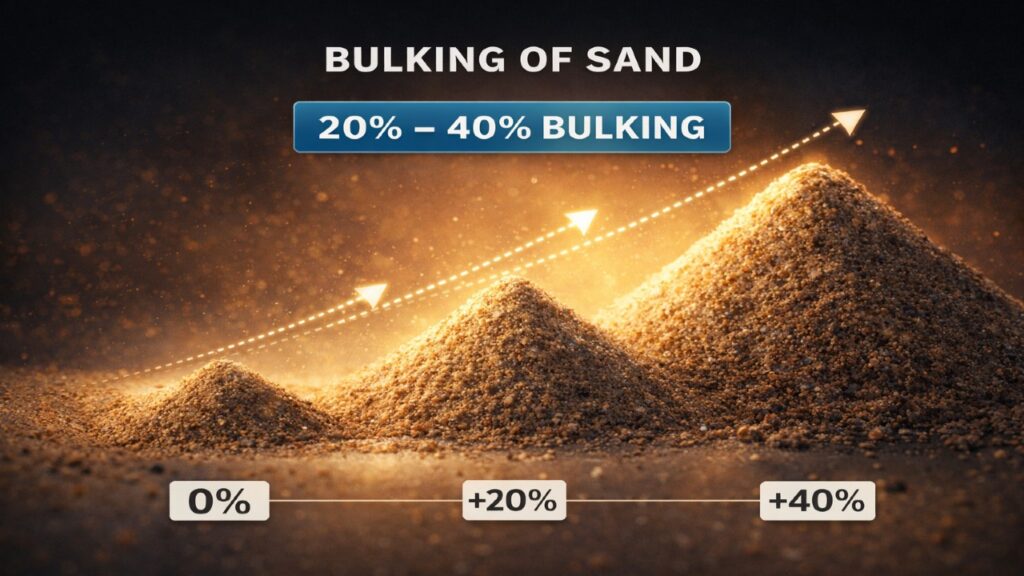
Bulking of Sand in Concrete to the increase in the volume of sand due to the presence of moisture.
When sand contains a small amount of water, a thin film forms around each sand particle. This film pushes the particles slightly apart from each other, increasing the overall volume of sand without increasing its weight.
In simple terms:
Volume increases
Weight remains the same
This means that if you measure sand by volume (as in volume batching), you may actually be using less sand than required.
Why Does Bulking Occur?
Bulking occurs because of surface tension created by moisture in sand. When water is present in small quantities:
It forms a coating around particles
It prevents particles from packing closely
It creates more voids between particles
As a result, sand appears “fluffy” or expanded.
Interestingly:
Dry sand → No bulking
Fully saturated sand → No bulking
Damp sand → Maximum bulking
This is why damp sand is the most dangerous condition in construction.
Percentage of Bulking in Sand
In practical construction scenarios, bulking of sand typically ranges between 20% and 30%, and in certain cases, it can even reach up to 40%, especially when the sand contains a moderate level of moisture, which is the condition where maximum bulking usually occurs.
This is particularly important because if you do not adjust the quantity of sand accordingly, the actual amount of sand used in the mix will be less than required, leading to incorrect mix proportions and ultimately affecting the strength and durability of the concrete.
Effect of Bulking of Sand in Concrete
Let’s understand this with an example.
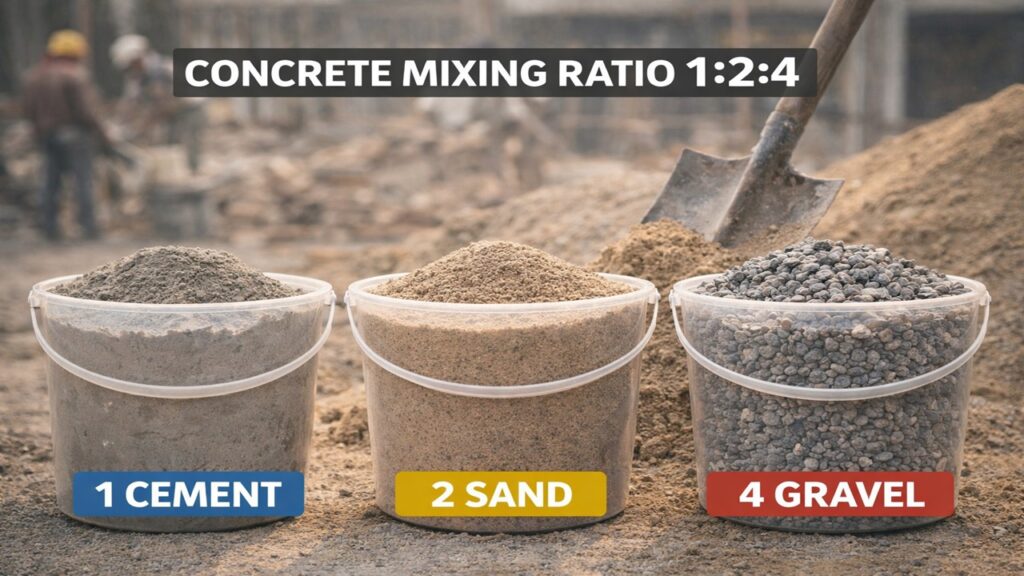
Suppose you are preparing concrete in a ratio of 1:2:4, which means 1 part cement, 2 parts sand, and 4 parts aggregate.
Now, if the sand is in a bulked condition and you still measure 2 parts by volume, the actual quantity of sand will be less than required.
This leads to incorrect mix proportions, which directly affects the quality of concrete. As a result, the strength of the concrete reduces, the chances of cracks increase, and the surface finish becomes poor. Over time, the durability of the structure also decreases.
In simple words, your structure becomes weaker than it was originally intended to be.
How to Identify Bulking of Sand on Site?
A simple field test can help you determine the bulking percentage of sand directly on-site.
First, take a container and fill it with sand, then mark the height of the sand level—let’s assume it is 100 mm. After that, slowly add water to the container until the sand becomes fully saturated. Once the sand is completely saturated, measure the new height again, which may reduce to around 80 mm.
To calculate the bulking percentage, use the following formula:
In this example, the calculation will be:
Bulking = (100 – 80) / 80 × 100 = 25%
This means that the volume of sand had increased by 25% due to the presence of moisture, which must be considered while doing volume batching to ensure accurate concrete mix proportions.
Once you know the bulking percentage, you can adjust the sand quantity accordingly.
Example:
If bulking = 25% Required sand = 2 pans
Adjusted sand = 2 × 1.25 = 2.5 pans
This ensures that you are using the correct actual quantity of sand.
Importance of Bulking Test
The bulking test is very important in construction because different types of sand behave differently, and their response to moisture can vary significantly. Additionally, the moisture content in sand does not remain constant—it can change daily depending on weather conditions. Rainfall, in particular, can drastically increase the moisture content, leading to higher bulking and inaccurate volume measurements if not checked properly.
Therefore, it is essential to perform the bulking test at the right time. You should always conduct this test whenever the source of sand changes, as different sources may have different properties. It is also highly recommended to perform the test after rainfall, since moisture levels can increase and affect batching accuracy. Most importantly, the test should be done before starting any major concreting work to ensure that the mix proportions remain correct and the quality of concrete is maintained.
Machine Mixing vs Hand Mixing
In machine mixing:
Better consistency is maintained
Chances of error are reduced
In hand mixing:
Human error is higher
Ignoring bulking can be more dangerous
Therefore, extra care is required when using manual mixing methods.
Best Solution: Weight Batching
The most effective way to eliminate bulking issues is weight batching.
Advantages:
High accuracy
No effect of moisture
Consistent mix quality
That’s why large construction projects always prefer weight batching.
However, in small projects, volume batching is still widely used due to cost and equipment limitations. Hence, understanding bulking becomes essential.
Role of Site Supervision
Many workers and masons are often not aware of the concept of bulking, and they usually rely on their past experience rather than proper technical knowledge. While experience is valuable, it is not always enough to ensure accuracy in construction, especially when factors like moisture variation come into play.
This is where the role of a site engineer becomes extremely important. A site engineer is responsible for checking the condition of sand before use, performing bulking tests whenever required, and ensuring that all measurements are taken correctly. Proper supervision also helps in maintaining overall quality control at the construction site.
If supervision is weak, even small mistakes can go unnoticed, and these minor errors can eventually lead to serious structural problems.
Impact of Rain on Bulking
After rainfall, the moisture content in sand increases suddenly, which can cause bulking to reach its maximum level. This significantly affects the volume of sand, making it appear more than it actually is.
If such sand is used without performing a proper bulking test, the mix design becomes inaccurate because the actual quantity of sand used will be less than required. As a result, the overall quality of concrete gets compromised, leading to reduced strength and durability.
Therefore, it is always important to perform a bulking test after rainfall to ensure correct mix proportions and maintain construction quality.
Key Takeaway: Measure What Matters
In construction, accuracy defines quality.
Correct measurement = Strong structure
Incorrect measurement = Weak structure
Bulking of Sand in Concrete is not just a theoretical concept—it directly impacts the strength, durability, and performance of concrete.
Conclusion
Bulking of Sand in Concrete may seem like a small concept, but its impact on construction quality is significant. Especially in countries like India, where volume batching is commonly used in small projects, understanding this concept is essential for engineers, contractors, and even homeowners.
If you want your building to remain strong and durable for years, do not ignore such technical details.
Next time you see sand on-site, don’t just look at it—analyze its condition, moisture content, and its effect on your concrete mix.
That awareness is what makes you a better engineer and a smarter builder.
REFERENCE VIDEO
If you want detailed knowledge, then watch this Reference video on YouTube Channel: Learning Civil Technology. Because many important points have been covered during the making of the video, so Must Watch.