Water Table Effect on Soil Bearing Capacity: Complete Guide for Safe Foundation Design
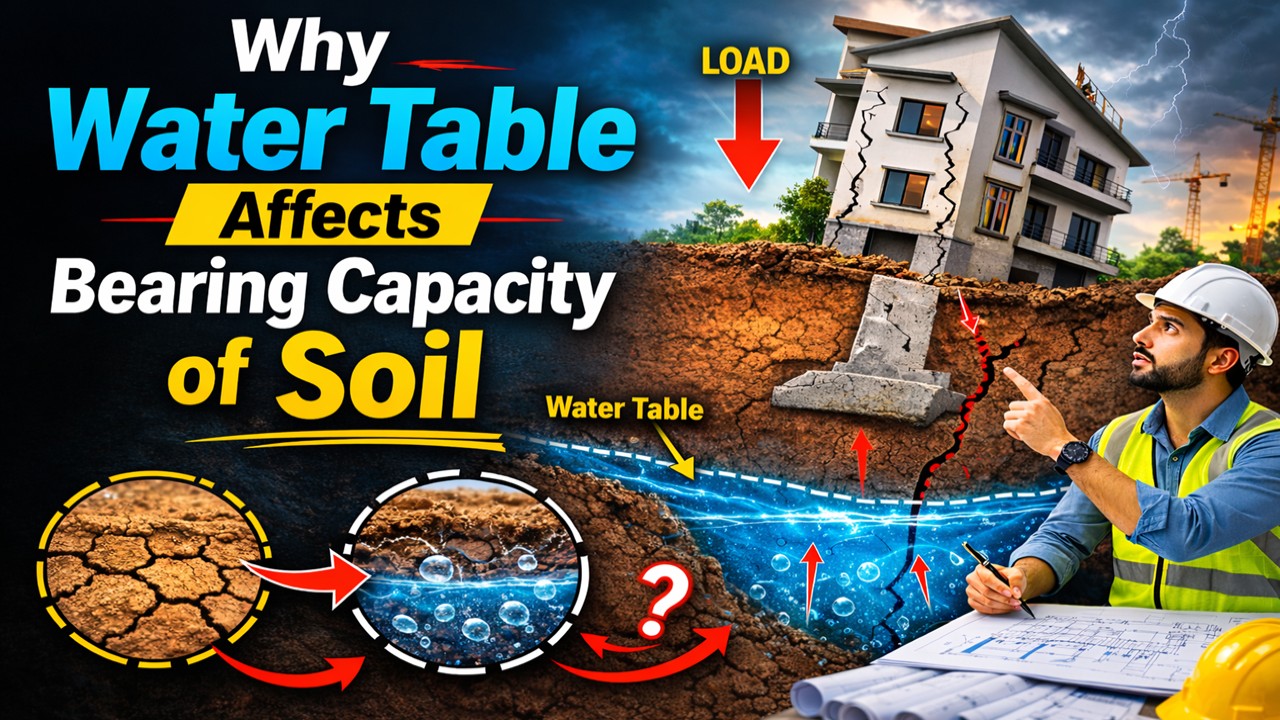
Whenever a building, house, or any structure is constructed, the first and most critical factor engineers consider is the soil’s bearing capacity. However, along with soil strength, another equally important factor is the water table effect on soil bearing capacity. Understanding the water table effect on soil bearing capacity is essential because it directly impacts foundation safety, structural stability, and long-term performance.
In simple terms, soil bearing capacity refers to how much load the ground can safely support. Since every structure ultimately rests on soil, any reduction in its strength can lead to settlement, cracks, or even structural failure. One of the key reasons behind such failures is often ignored—the water table effect on soil bearing capacity.
What is Water Table in Soil?
To understand the water table effect on soil bearing capacity, we first need to understand what a water table is.
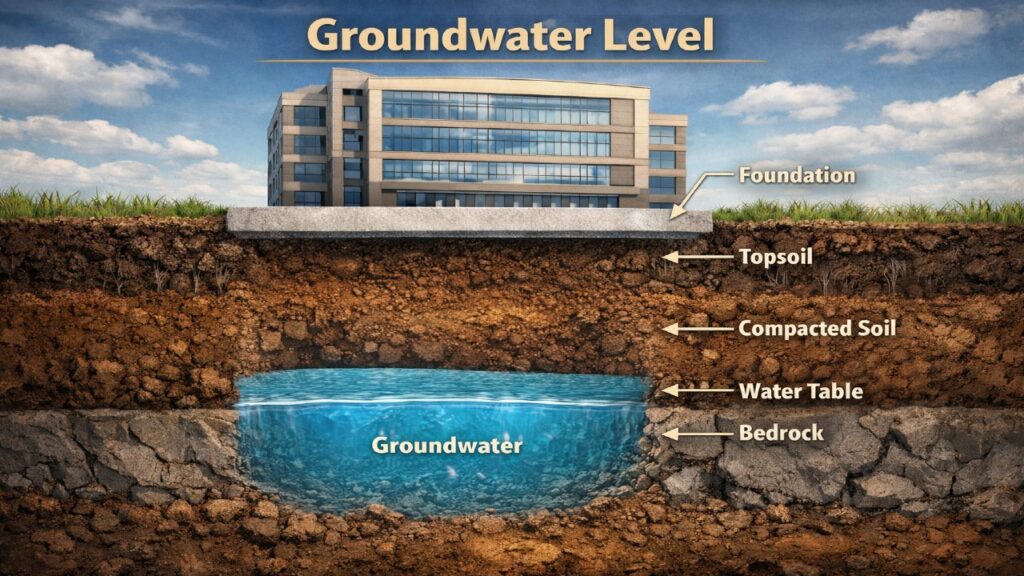
Below the ground surface, soil contains particles with empty spaces between them, known as voids. These voids may contain air or water. At a certain depth, all these voids become completely filled with water. This level is called the water table.
In simple words, the water table is the level below which soil is fully saturated with water. This saturation plays a major role in the water table effect on soil bearing capacity.
Understanding Effective Stress and Its Role
The concept of effective stress is very important in understanding the water table effect on soil bearing capacity.
Effective stress is the stress transferred between soil particles through direct contact. This stress determines how strong the soil is.
Dry soil → high contact between particles → high strength
Saturated soil → reduced contact → low strength
When the water table rises, water fills the voids and reduces particle contact. This is the core reason behind the water table effect on soil bearing capacity.
How Water Table Reduces Soil Bearing Capacity
The water table effect on soil bearing capacity becomes clearly visible when groundwater rises near the foundation level.
When soil becomes saturated:
Friction between soil particles decreases
Effective stress reduces
Soil becomes weaker
Load carrying capacity decreases
This is why engineers always study the water table effect on soil bearing capacity before designing foundations.
Practical Example of Water Table Effect
A simple example helps understand the water table effect on soil bearing capacity.
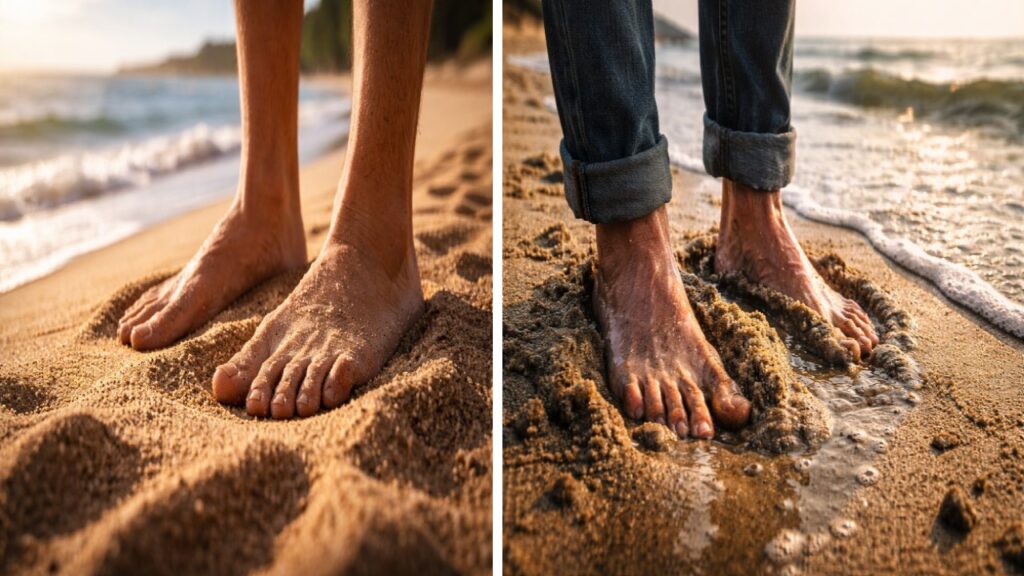
If you stand on dry sand, it supports your weight easily. But when the same sand becomes wet or fully saturated, your feet start sinking.
This happens because water reduces friction between particles. The same phenomenon occurs in soil beneath foundations due to the water table effect on soil bearing capacity.
The position of groundwater plays a major role in the water table effect on soil bearing capacity.
Water Table Below Foundation
Soil remains dry
High effective stress
High bearing capacity
Water Table Near or Above Foundation
Soil becomes saturated
Effective stress reduces
Bearing capacity decreases
Thus, the water table effect on soil bearing capacity depends greatly on groundwater depth.
Buoyancy Effect and Soil Strength
Another important aspect of the water table effect on soil bearing capacity is the buoyancy effect.
When soil is submerged, water exerts an upward force, reducing the effective weight of soil particles.
As a result:
Effective unit weight decreases
Contact pressure reduces
Soil strength decreases
This is why engineers consider submerged unit weight when analyzing the water table effect on soil bearing capacity.
Seasonal Variation in Water Table
The water table effect on soil bearing capacity is not constant throughout the year.
During monsoon → water table rises
During summer → water table falls
Engineers must consider these variations while designing foundations. Ignoring seasonal changes can lead to failure due to unexpected water table effect on soil bearing capacity.
Pore Water Pressure and Its Impact
Another key factor in the water table effect on soil bearing capacity is pore water pressure.
When saturated soil is loaded:
Water inside voids cannot escape quickly
Pressure builds up inside soil
Effective stress decreases
This reduces soil strength further and increases settlement.
Consolidation Settlement in Clay Soil
The water table effect on soil bearing capacity is especially severe in clay soils.
Clay drains water very slowly, leading to:
Long-term settlement
Cracks in structures
Uneven foundation behavior
This phenomenon is known as consolidation settlement.
High Water Table Areas
The water table effect on soil bearing capacity is more critical in areas like:
Riverbanks
Coastal regions
Marshy lands
Low-lying areas
In these regions, soil is almost always saturated, making foundation design more challenging.
Impact on Foundation Design
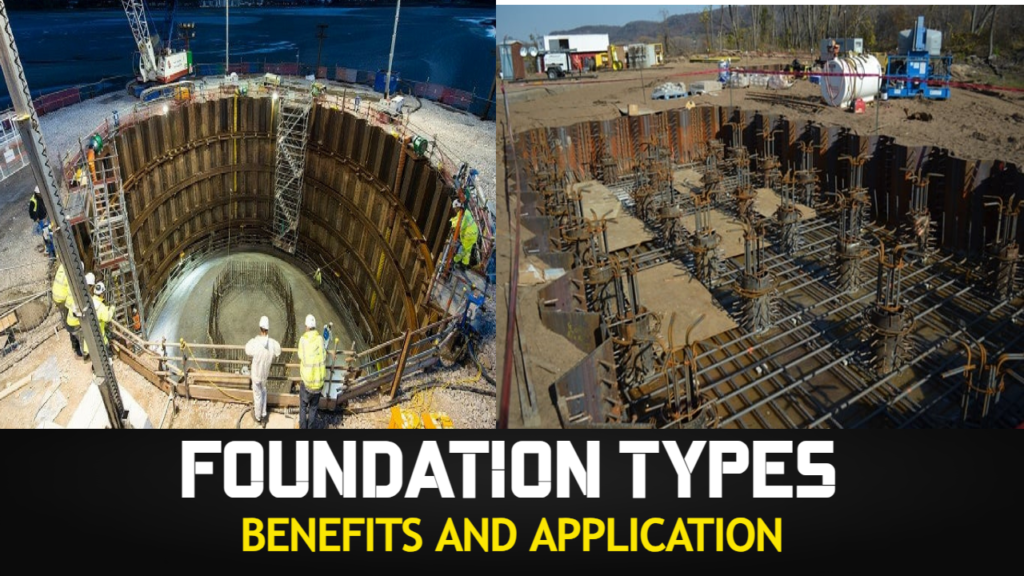
The water table effect on soil bearing capacity directly influences foundation selection.
Problems with Shallow Foundations
Shallow foundations may fail due to:
Reduced bearing capacity
Excessive settlement
Solutions in High Water Table Conditions
To counter the water table effect on soil bearing capacity, engineers use:
Raft Foundation
Distributes load over a large area
Pile Foundation
Transfers load to deeper strong layers
These methods reduce the impact of the water table effect on soil bearing capacity.
Construction Challenges Due to Water Table
During construction, the water table effect on soil bearing capacity creates practical issues.
Excavation Problems
Water enters excavation pits
Soil becomes unstable
Work becomes difficult
Dewatering Techniques
To manage the water table effect on soil bearing capacity, engineers use dewatering methods:
Well point system
Deep wells
Sump pumping
These techniques temporarily lower groundwater levels.
Uplift Pressure Problem
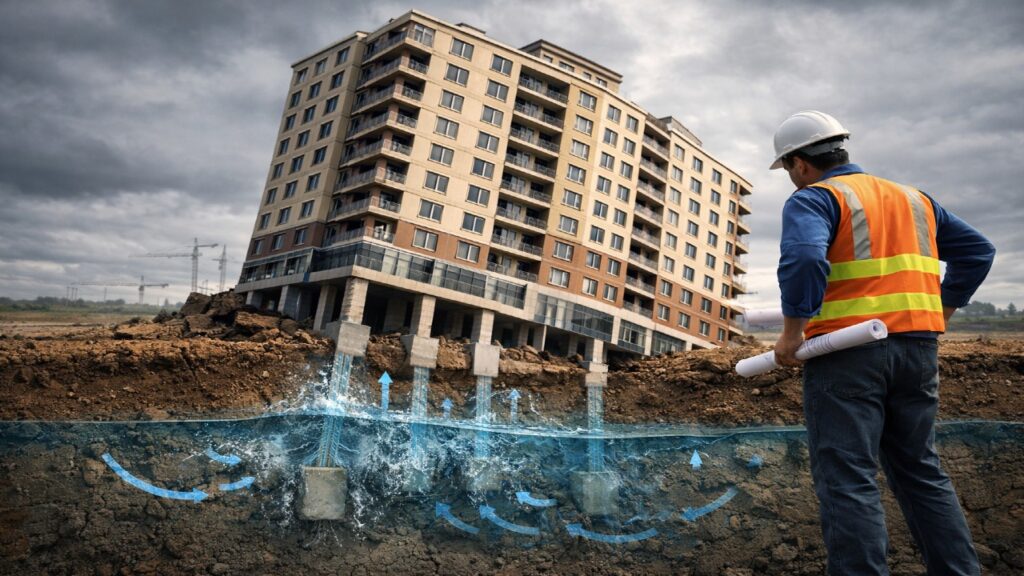
The water table effect on soil bearing capacity also causes uplift pressure.
Water below the foundation pushes upward. If this pressure exceeds structural weight:
Cracks may develop
Foundation may lift
Solutions include:
Increasing foundation thickness
Providing drainage systems
Seepage and Soil Erosion
The water table effect on soil bearing capacity also includes seepage problems.
Flowing groundwater can carry soil particles, leading to:
Weakening of soil
Settlement
Structural instability
Proper drainage and filters are used to control this.
Real-Life Construction Issue
In many projects, people ignore the water table effect on soil bearing capacity while buying land.
Later during excavation:
Water appears at shallow depth
Construction cost increases
Additional work is required
This is why soil testing is essential.
Conclusion
The water table effect on soil bearing capacity is one of the most important factors in construction engineering. Ignoring the water table effect on soil bearing capacity can result in settlement, cracks, and structural failure.
A strong building is not just about concrete and steel—it depends on proper soil understanding and foundation design. That is why engineers always analyze the water table effects on soil bearing capacity before construction.
👉 The real strength of a building lies beneath the ground.
REFERENCE VIDEO
If you want detailed knowledge, then watch this Reference video on YouTube Channel: Learning Civil Technology. Because many important points have been covered during the making of the video, so Must Watch.
What is the water table effect on soil bearing capacity?
The water table effect on soil bearing capacity refers to how groundwater reduces the strength of soil. When the water table rises, it fills the voids between soil particles, reducing friction and effective stress, which ultimately lowers the soil’s load-carrying capacity.
How does a high water table affect foundation design?
A high water table significantly impacts foundation design because it reduces soil strength. Due to the water table effect on soil bearing capacity, engineers often use raft or pile foundations instead of shallow footings to ensure stability and safety.
Why does soil lose strength when the water table rises?
Soil loses strength due to the water table effects on soil bearing capacity because water reduces contact between soil particles, decreases friction, and increases pore water pressure. This lowers effective stress, which is responsible for soil strength.
How can engineers manage the water table effect during construction?
Engineers manage the water table effects on soil bearing capacity using techniques like dewatering (well points, sump pumping), proper drainage systems, and selecting suitable foundation types such as pile foundations to transfer loads to deeper, stronger soil layers.
Is soil testing necessary to check water table level before construction?
Yes, soil testing is essential to evaluate the water table effects on soil bearing capacity. It helps engineers determine groundwater levels, soil type, and strength, ensuring safe and cost-effective foundation design.