Ready Mix Concrete vs Site Mix Concrete: Which is Better for House Construction
Friends, just imagine this…
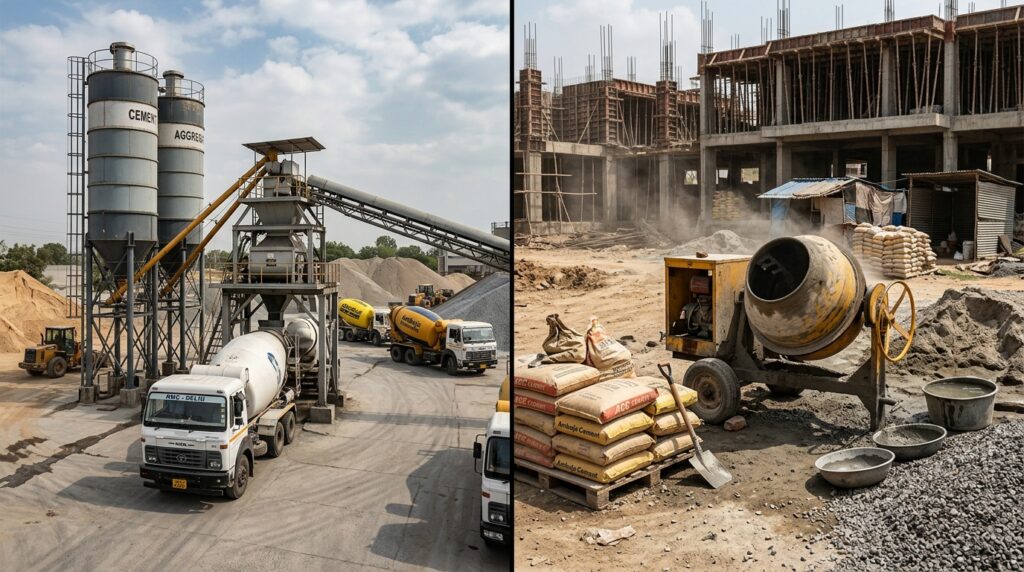
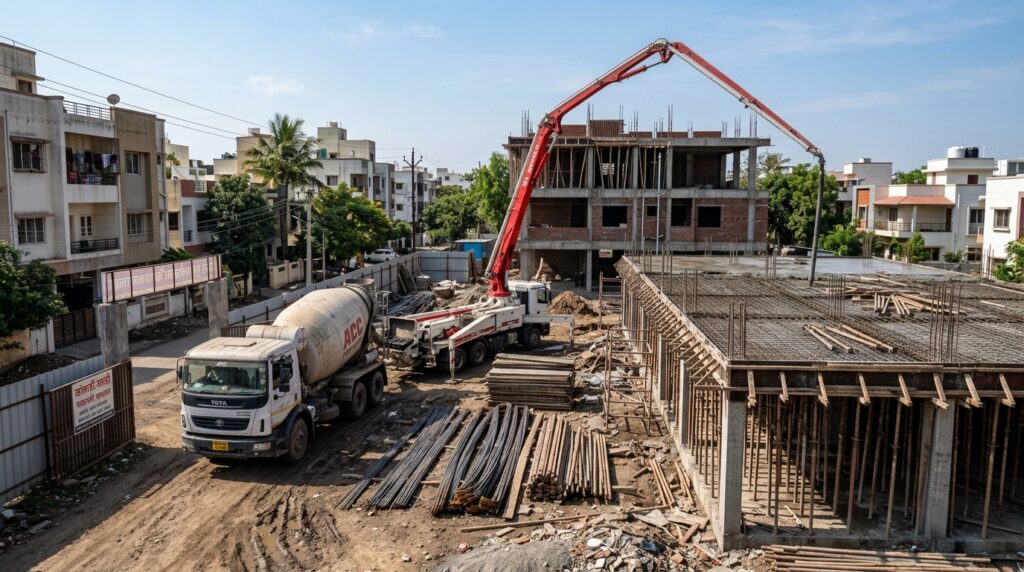
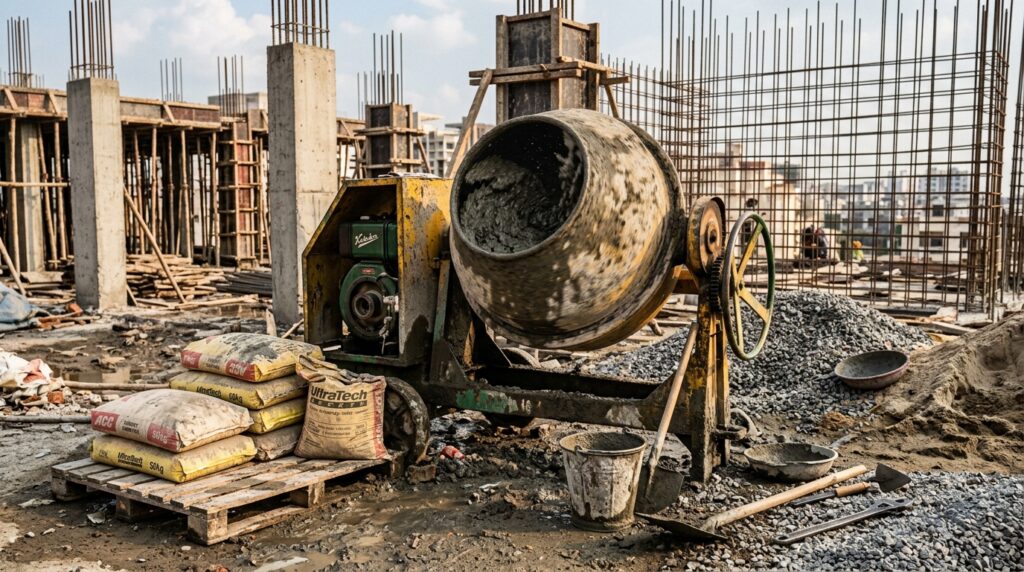
The roof slab of your dream house is being cast. On one site, a large Ready Mix Concrete (RMC) truck arrives, and within a short time, the entire slab is poured with the help of a concrete pump. On another site, workers are manually preparing concrete by mixing cement, sand, aggregates, and water in a mixer machine.
Concrete is being used in both cases, but the real question is—which one is actually better?
Is Ready Mix Concrete always stronger than Site Mix Concrete? Or is Site Mix Concrete more reliable? Is RMC meant only for large construction projects, or can homeowners building an ordinary house also use it? And most importantly, if you’re building your dream home, which option should you choose?
In this article, we’ll answer all of these questions in simple language. By the end, you’ll also learn the situations where Ready Mix Concrete may not be the right choice.
First, let’s understand what Ready Mix Concrete (RMC) actually is.
As the name suggests, Ready Mix Concrete is prepared in a modern batching plant rather than at the construction site. Computer-controlled machines accurately mix cement, sand, aggregates, water, and, when required, chemical admixtures in the exact proportions specified by the mix design. The prepared concrete is then loaded into specially designed transit mixer trucks and delivered directly to the construction site.
This means there is no need to mix cement, sand, and aggregates separately on-site.
Now let’s talk about Site Mix Concrete.
This is the traditional method that has been used for many years in small and medium-sized construction projects. In this process, cement, sand, aggregates, and water are mixed directly at the construction site. In many places, workers still mix concrete manually, while others use small concrete mixer machines.
The quality of Site Mix Concrete largely depends on whether the materials are measured correctly and how well the mixing process is carried out.
Now the question is—why is Ready Mix Concrete often considered superior?
The biggest reason is consistency. Since the entire production process is controlled by computers at the batching plant, every batch is produced with nearly identical proportions. As a result, the quality of the concrete remains much more consistent.
In contrast, with Site Mix Concrete, if a little extra water is added or the cement quantity is reduced in even one batch, the strength of the concrete can be affected.
You may have often heard that the more water you add to concrete, the lower its strength can become. That’s why the water-cement ratio is carefully controlled in Ready Mix Concrete plants.
However, at construction sites, workers sometimes add extra water to make the concrete easier to place or to finish the work more quickly. While this may make the concrete flow better, the additional water can reduce its strength and increase the chances of cracks developing later.
This is why using good materials alone isn’t enough—the correct proportions are equally important.
Now let’s discuss construction speed.
Suppose you need to cast an entire roof slab in a single day.
If you’re using Site Mix Concrete, workers must continuously measure materials, mix them, transport the concrete, and lift it to the required location. This entire process takes considerable time.
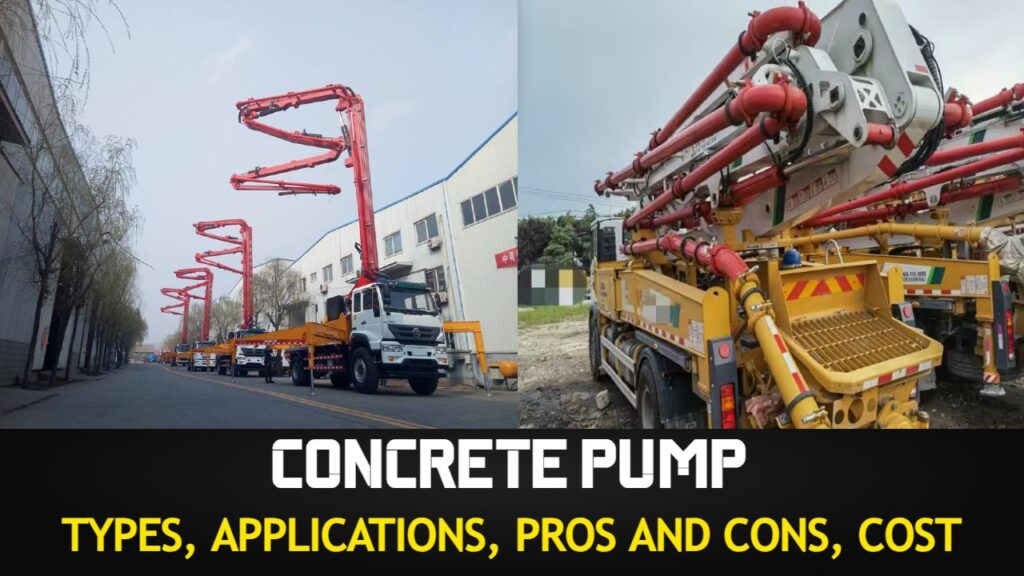
On the other hand, Ready Mix Concrete arrives directly from the batching plant and can be pumped into the slab quickly using a concrete pump. This allows the entire slab to be cast continuously without unnecessary interruptions.
For large construction projects, this uninterrupted concreting process is extremely important.
But does that mean Site Mix Concrete is always inferior?
Absolutely not.
If high-quality materials are used, the correct mix design is followed, measurements are accurate, mixing is done properly, and experienced engineers supervise the work, Site Mix Concrete can also produce excellent quality concrete.
Problems arise only when proper construction practices are ignored.
In many cases, cement is added by estimation instead of accurate measurement, water is added by guesswork, and no quality checks are performed. Under such circumstances, the final strength and durability of the concrete can be compromised.
Another important difference is material wastage.
With Site Mix Concrete, some cement may spill, sand can get scattered, and excess mixed concrete may remain unused after the work is completed. This often leads to unnecessary material wastage.
In contrast, Ready Mix Concrete is generally ordered according to the required quantity, allowing better utilization of materials and reducing waste in many situations.
Now let’s talk about laboratory testing and quality control.
Reputable Ready Mix Concrete manufacturers regularly test cement, aggregates, sand, and the finished concrete in their laboratories. This helps maintain consistent quality throughout production.
With Site Mix Concrete, however, maintaining identical quality in every batch becomes difficult unless an engineer or supervisor continuously monitors the entire process.
This is one of the major reasons why large infrastructure projects, high-rise buildings, flyovers, bridges, and metro rail projects extensively use Ready Mix Concrete.
However, every option has its limitations.
Many people believe that Ready Mix Concrete is always both cheaper and better. In reality, that’s not entirely true.
If your construction site is located far away from the city where no RMC plant is available, or if the transit mixer requires a long travel time to reach the site, Ready Mix Concrete may not be the most practical solution.
Concrete has a limited workable time, and it must be placed before that time expires. Delays in transportation can affect its workability and overall quality.
This is why selecting the right option isn’t simply about choosing the more modern technology.
You should consider the size of your project, the location of your site, the availability of quality control, the resources available, and your overall budget.
For many small residential houses, a properly prepared Site Mix Concrete can be the most suitable option, while for larger projects, Ready Mix Concrete often provides better quality, faster construction, and greater efficiency.
Now comes the most important question.
If you’re building your own house, should you choose Ready Mix Concrete or Site Mix Concrete?
There isn’t a single answer that applies to every project.
If you’re constructing a multi-storey building, a commercial project, a large housing society, or any project where a significant quantity of concrete needs to be placed in a single day, Ready Mix Concrete is generally an excellent choice. It allows faster construction, better quality control, and more consistent concrete throughout the project.
On the other hand, if you’re building a typical residential house with relatively small concrete requirements, your site is located far from an RMC plant, or Ready Mix Concrete isn’t easily available nearby, Site Mix Concrete can also be an excellent choice.
There’s just one condition—the work must be carried out properly.
Correct proportions, high-quality materials, proper mixing, adequate vibration, and most importantly, proper curing are essential.
Remember, whether the concrete is Ready Mix Concrete or Site Mix Concrete, if curing is neglected, its strength and durability will be affected.
Now let’s discuss the cost.
Many people assume that Ready Mix Concrete is always more expensive, but that’s not completely true.
For large projects requiring many workers and faster execution, Ready Mix Concrete can often reduce both construction time and overall project costs.
However, for smaller projects with limited concrete requirements, Site Mix Concrete may prove to be the more economical choice.
Finally, always remember one important thing.
The secret behind strong and durable concrete isn’t where it was prepared—it’s how it was prepared, how it was placed, and how well it was cured afterward.
A scientifically prepared Site Mix Concrete can perform exceptionally well, while even Ready Mix Concrete can fail to deliver its expected quality if it isn’t handled properly.
So, instead of making your decision based only on the name, choose the option that best suits your project based on sound engineering principles.
If you found this information helpful, don’t forget to share it with anyone planning to build a new home or involved in construction.
And if you’d like to learn more about Civil Engineering, Construction Technology, Site Execution, and Practical Engineering in simple language, be sure to follow Learning Civil Technology.
See you in the next article with another interesting engineering topic.
REFERENCE VIDEO
If you want detailed knowledge, then watch this Reference video on YouTube Channel: L&T. Because many important points have been covered during the making of the video, so Must Watch.