What is Pre-Tensioning in Prestressed Concrete? Construction Process, Working & Applications
Friends, when we look at bridges, railway sleepers, concrete poles, or precast concrete structures, have you ever wondered how these structures can withstand heavy loads even though concrete has relatively low tensile strength?
Ordinary concrete is very strong in compression, but when it experiences tension, cracks can develop easily. To reduce this problem and improve the performance of concrete, prestressed concrete technology is used. One of the most important methods of prestressing is Pre-Tensioning.
In today’s video, we will understand in detail what pre-tensioning is, how it works, what its construction process involves, what its advantages and limitations are, and where it is used in civil engineering projects.
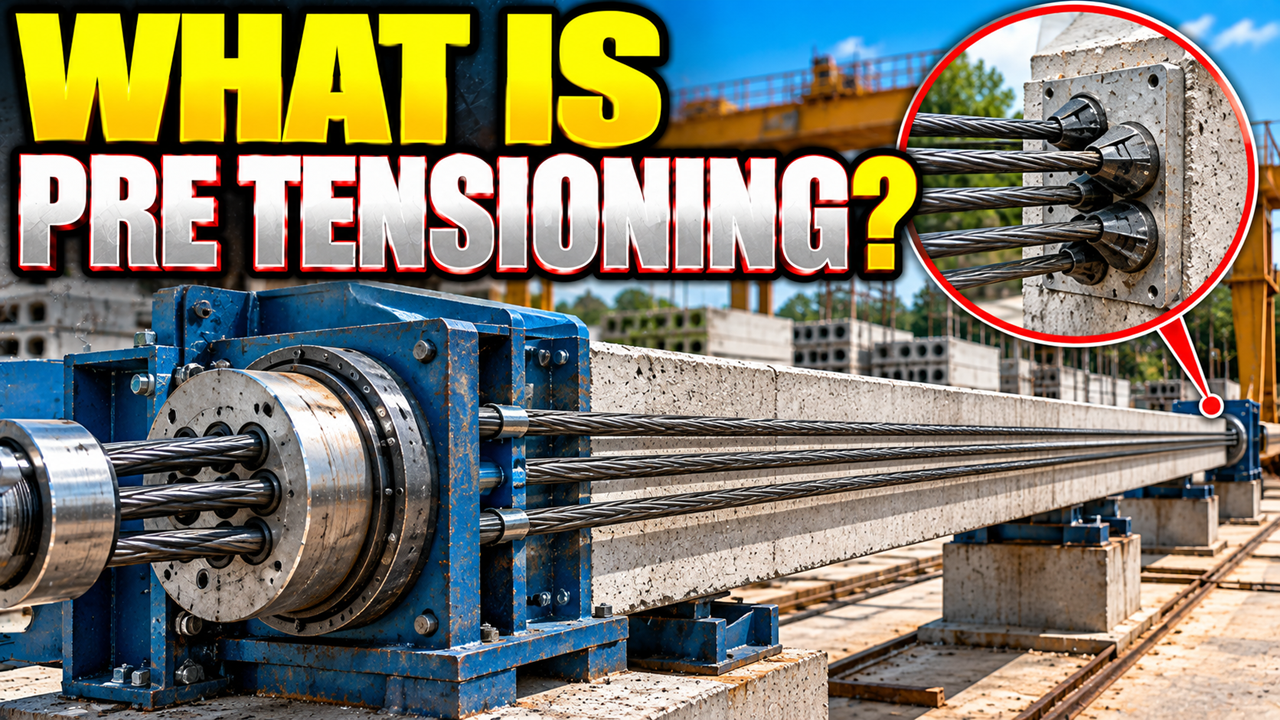
First, let’s understand what pre-tensioning actually is. Pre-tensioning is a prestressing technique in which high-strength steel wires or strands are stretched and tensioned before concrete is poured.
These steel tendons are stretched between anchorage systems installed at the ends of a strong casting bed or against suitable abutments. After tensioning the steel strands, formwork is installed around them, and concrete is poured into the mould.
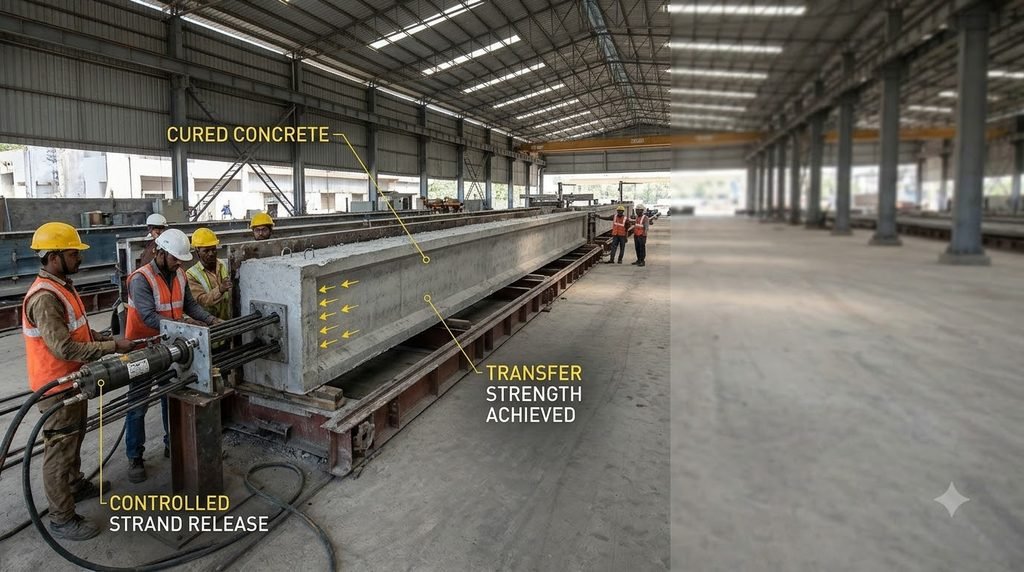
Once the concrete achieves the required strength, the steel strands are gradually released in a controlled manner. At this stage, the steel tries to return to its original length. However, because the steel is bonded to the surrounding concrete, it transfers a compressive force to the concrete member.
Through this process, compression is introduced into the concrete before external loads are applied. This pre-existing compression is known as prestress.
Let’s understand this with a simple example. Imagine you have a concrete beam. When a load acts on the beam, tension develops in its lower portion due to bending. If this tensile stress exceeds the tensile capacity of concrete, cracks may develop.
However, if compressive stress is introduced into the beam beforehand, the tensile stress generated by external loading can be partially counteracted.
This is the basic principle of pre-tensioning: introducing controlled compression into concrete before it experiences service loads. This helps control cracking and improve the structural performance of the member.
Now, there is one important point you should understand.
In pre-tensioning, the prestressing steel is tensioned before the concrete is cast. In contrast, in post-tensioning, the tendons are tensioned after the concrete has been cast and achieved the required strength.
Both methods aim to introduce prestress into concrete, but their construction processes and anchorage systems are different.
In pre-tensioning, the force is transferred from the steel to the concrete through bond between the two materials. In a conventional post-tensioning system, the prestressing force is transferred primarily through end anchorages.
Now, let’s understand the different components used in pre-tensioning.
The first important component is high-strength steel wire or strand. Compared with conventional reinforcement bars, prestressing steel has significantly higher tensile strength. This allows it to withstand high tensile forces and develop the required prestress in the concrete member.
The second component is the casting bed, where precast concrete members are manufactured.
The third component is the abutment and anchorage system. These components resist the large forces generated when the steel strands are tensioned.
In addition to these components, hydraulic jacks, stressing equipment, formwork, concrete mix, and curing arrangements are also important parts of the pre-tensioning process.
Now, let’s understand the construction process of pre-tensioning step by step.
Step 1: Preparation of the Casting Bed and Anchorage System
The first step is to prepare the casting bed and anchorage system.
The casting bed must be strong, stable, and properly designed because very large forces act on the anchorage system during the tensioning of prestressing steel.
If the casting bed or anchorage system does not have sufficient capacity, it can create serious safety risks.
Therefore, the design, installation, and inspection of these systems must be carried out under the supervision of qualified professionals.
Step 2: Placing and Tensioning the Steel Strands
In the second step, high-strength steel wires or strands are installed between the anchorage points located at the ends of the casting bed.
The number, diameter, and spacing of the strands are determined according to the structural design.
After placing the strands, they are tensioned to the specified force using hydraulic jacks or suitable stressing equipment.
During this process, both the applied force and the elongation of the steel strands must be carefully monitored.
Simply pulling the strands based on an estimate is not an acceptable method.
The applied force, measured elongation, and equipment calibration must be verified according to the approved stressing procedure.
Step 3: Installation of Formwork and Placement of Concrete
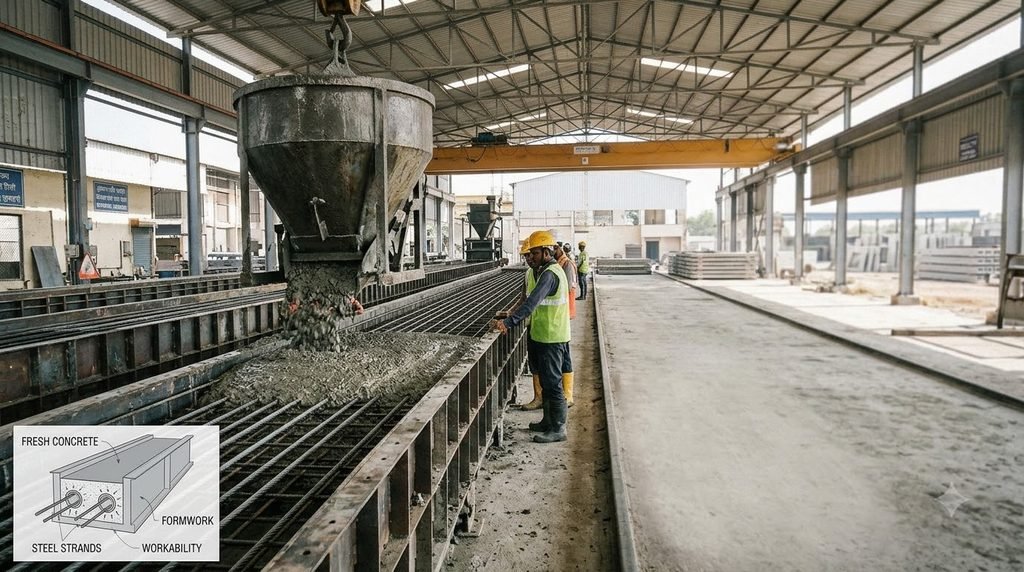
In the third step, reinforcement, inserts, and formwork are arranged around the tensioned strands according to the approved structural drawings.
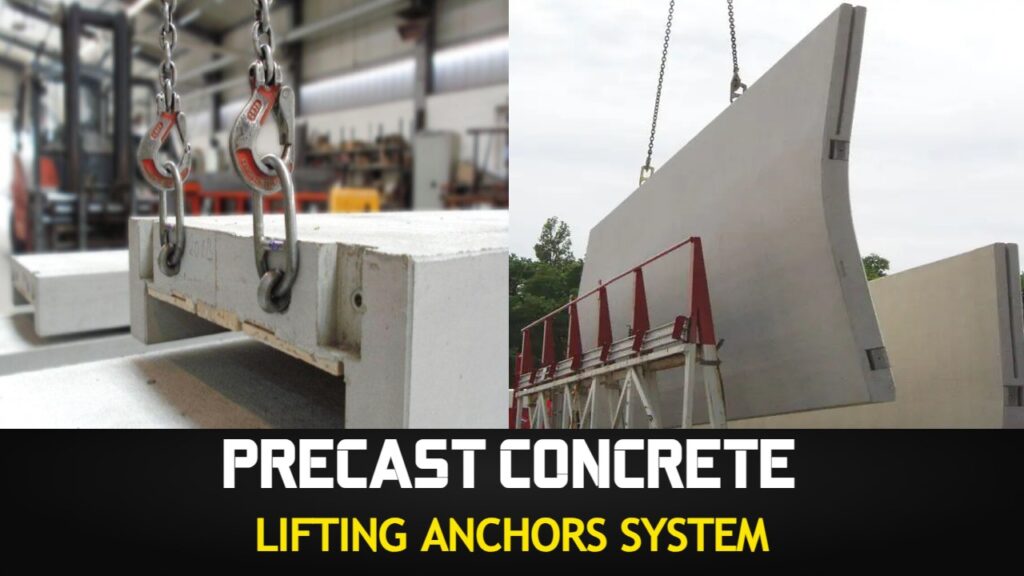
If the concrete member requires lifting hooks, embedded plates, or other fittings, these must also be fixed in their correct positions.
After completing these arrangements, concrete is placed into the formwork.
The concrete mix must have suitable workability so that it can flow properly around the reinforcement and prestressing strands.
Appropriate vibration and approved concrete placement methods are used wherever necessary to avoid defects such as honeycombing and voids.
Proper placement and compaction are essential for achieving the required concrete quality.
Step 4: Curing of Concrete
After placing the concrete, the next step is curing.
Curing is particularly important in pre-tensioning because the concrete must achieve the specified transfer strength before the prestressing strands can be released.
In some precast manufacturing plants, accelerated curing or steam curing may also be used to speed up production.
However, the temperature and curing cycle must be properly controlled to ensure that the concrete develops the required properties.
Step 5: Release of the Prestressing Strands
Once the concrete achieves the required transfer strength, the prestressing strands are gradually released in a controlled sequence.
At this stage, the tensile force stored in the steel begins to transfer to the concrete.
Because of the bond between the strands and the surrounding concrete, compressive stress develops within the concrete member.
The transfer of force does not occur instantly over the entire length of the member. Instead, it takes place gradually over a certain length near the ends.
This length is known as the transfer length.
The controlled release of the strands is extremely important because sudden or improper release can damage the concrete member and create serious safety hazards.
Step 6: Removal, Inspection, and Transportation
After releasing the strands, the concrete member is separated from the casting bed or lifted safely using suitable lifting arrangements.
The member is then inspected for dimensional accuracy, surface defects, and other quality requirements.
After completing the necessary inspections, the precast element is stored in the storage yard or transported to the project site.
During lifting and transportation, the member may experience bending and handling stresses. Therefore, lifting points and handling procedures must be selected according to the structural design.
Proper transportation planning is essential to prevent damage to the precast member.
Now, let’s understand how Pre-Tensioning actually works.
When an external load acts on a concrete member, bending can produce compression in one part of the section and tension in another.
The compressive stress introduced through pre-tensioning helps counteract the tensile stress generated by external loads.
As a result, cracking can be controlled under service conditions, and the deflection performance of the member may improve.
However, the actual performance depends on several factors, including the geometry of the member, prestressing force, prestress losses, concrete properties, and applied loads.
This does not mean that pre-tensioned concrete can never crack or that it is protected from failure under every possible condition.
Proper structural design, construction quality, and inspection remain essential.
Another important aspect of pre-tensioning is prestress loss.
The effective prestress in a concrete member may decrease over time due to several factors.
For example, shrinkage and creep of concrete, relaxation of prestressing steel, and effects associated with the transfer of prestressing force can reduce the effective prestress.
These losses must be estimated appropriately during structural design so that the member continues to meet the required performance criteria throughout its service life.
Now, let’s discuss the advantages of pre-tensioning.
The first major advantage is high-quality precast production. Since most manufacturing takes place in a controlled factory environment, better control can be maintained over the concrete mix, casting process, curing, and quality inspections. This helps achieve consistent production quality.
The second advantage is the ability to manufacture long-span and slender structural members. With a suitable design, pre-tensioned beams and slabs can carry the required loads with relatively smaller depths. In some projects, this can help optimize structural weight and material consumption.
The third advantage is improved crack control. Because prestressing introduces compression into concrete, the tensile stress developed under service loads can be reduced. This helps control the development and width of cracks, depending on the design and loading conditions.
The fourth advantage is faster construction. Precast concrete members can be manufactured in a factory while other activities are being carried out at the project site. Once the members are ready, they can be transported and installed at the site. This can reduce the time required for on-site shuttering, casting, and curing activities, helping accelerate the overall construction schedule.
Now, let’s understand the limitations of pre-tensioning.
The first major limitation is the requirement for specialized infrastructure. Pre-tensioning requires strong casting beds, heavy anchorage systems, and specialized stressing equipment. As a result, the initial setup cost can be relatively high.
The second limitation is that pre-tensioning is generally more practical in precast factories or dedicated casting facilities. When a large number of identical structural members need to be manufactured, the production process can become more economical. However, for small projects involving different member sizes and shapes, pre-tensioning may not always be the most economical option.
The third limitation is related to transportation and handling. Large precast members manufactured in a factory must be transported safely to the construction site. This requires suitable road access, lifting equipment, transportation planning, and installation arrangements. In some projects, transportation constraints can significantly affect the feasibility of using large precast elements.
The fourth limitation is design and production flexibility. Because the casting bed, formwork, and manufacturing arrangements are designed for specific types of members, producing many different shapes and sizes can become expensive and time-consuming. Therefore, pre-tensioning is particularly suitable for projects where repeated production of similar structural elements is required.
In addition, safety precautions are extremely important during prestressing and strand release. Prestressing steel contains a significant amount of stored energy while under tension. If a strand or anchorage system suddenly releases, it can cause a serious accident. For this reason, stressing operations must follow approved safety procedures, and unauthorized personnel must be kept away from hazardous areas.
Now, let’s understand where pre-tensioning is used in civil engineering.
One of its most common applications is in precast concrete railway sleepers.
Railway sleepers must withstand repeated loading, vibration, and environmental exposure. Prestressed concrete technology is useful in manufacturing sleepers that meet the required structural performance criteria.
Pre-tensioning is also used in precast bridge girders and beams. In bridges, prestressed members can help achieve the required load-carrying capacity and span with suitable structural dimensions.
Another application is in industrial buildings, where pre-tensioned precast roof members and other structural elements may be used.
It is also used in precast floor units, concrete electric poles, and certain types of precast concrete piles.
Pre-tensioning can be particularly useful in projects where a large number of identical structural members must be manufactured under controlled factory conditions.
However, remember one important point: the selection between pre-tensioning and post-tensioning should never be based on cost alone.
Several factors must be considered, including the span, loading conditions, transportation constraints, site conditions, production volume, and structural requirements.
The most suitable method is the one that satisfies the project’s engineering requirements while providing an appropriate balance between safety, quality, construction efficiency, and cost.
So, friends, I hope you now have a clear understanding of pre-tensioning, its construction process, working principle, advantages, limitations, and applications.
REFERENCE VIDEO
If you want detailed knowledge, then watch this Reference video on YouTube Channel: L&T. Because many important points have been covered during the making of the video, so Must Watch.
If you enjoy practical educational videos related to civil engineering, construction technology, and site engineering, make sure to subscribe to our L&T – Learning Technology channel.
Share this video with your civil engineering students, fellow engineers, contractors, and site engineers who want to improve their technical knowledge.